
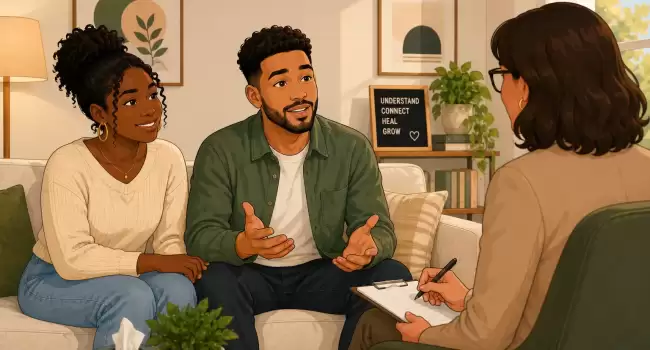
Starting couples counseling can feel uncertain, especially if neither of you has been to therapy together before. While the exact process and policies vary by clinician, most first sessions follow a similar shape: getting to know each of you, understanding what brought you in, and starting to build a shared sense of direction. Knowing roughly what to expect can make that first step feel less intimidating.
It’s also common for partners to walk in with different expectations — one person may want to dive straight into a specific conflict, while the other wants space to be heard first. A good first session makes room for both, without requiring you to agree on everything before you begin.
Before the First Appointment
Many couples find it helpful to talk beforehand about what each of you hopes to get out of counseling — not to align on every detail, but to walk in with a general sense of what’s important to you individually. It’s normal for partners to have different reasons for seeking support, and a good first session leaves room for both perspectives.
It can also help to think about logistics ahead of time — whether you’re attending together in person or by telehealth, and whether either of you wants to raise something privately with the therapist beforehand. There’s no single right way to prepare; showing up with an open mind matters more than arriving with a perfect summary of the relationship.
What Happens in the Opening Minutes
A therapist will typically start by introducing how they work and answering any questions about the process. From there, the conversation usually turns to what brought you in — the concerns, patterns, or moments that led you to seek support together.
This part of the session is often less about digging into specifics and more about giving the therapist a general sense of your relationship’s shape: how long you’ve been together, what’s changed recently, and what each of you is hoping will be different.
Questions a Couples Therapist May Ask
Every clinician has their own style, but early questions often explore the relationship’s history, how you communicate under stress, what’s working well, and what feels stuck. A therapist may also ask about individual factors — stress, health, family background — that shape how each of you shows up in the relationship.
Some therapists also ask each partner to describe the same situation separately, which can surface how differently two people can experience the same moment. This isn’t about determining who’s “right” — it’s information the therapist uses to understand the dynamic between you.
How Goals and a Treatment Plan Are Developed
After understanding your shared concerns and history, a therapist can help translate that into goals you both recognize as meaningful — not a generic communication checklist, but priorities specific to your relationship. This is typically an ongoing conversation that gets refined over the first several sessions, not something finalized in the first hour.
Goals might range from very concrete (reducing a specific recurring conflict) to broader (feeling more like a team again). Part of the therapist’s role is helping you name what “better” would actually look like for your relationship specifically, rather than assuming a one-size-fits-all definition.
Confidentiality, Safety, and Individual Check-Ins
Confidentiality in couples work can be structured differently than in individual therapy, and policies on individual disclosures vary by clinician and practice. It’s worth asking your therapist directly, early on, how they handle information shared one-on-one versus in joint sessions.
Therapists also routinely screen for safety concerns or coercive dynamics, since these factors can affect whether joint sessions are appropriate at all. If that’s the case, a therapist may recommend a different course of support — this isn’t a judgment on either partner, but a standard part of responsible practice.
What Happens After the First Session
A first session is usually about orientation and information-gathering rather than resolution. It’s normal to leave without a finished plan — the work of couples counseling unfolds over time, and a therapist can help you understand what the next several sessions are likely to focus on.
Many couples notice that the first session already shifts something, simply from having a structured space to talk without the conversation escalating the way it might at home. That alone isn’t the goal, but it’s often an early, encouraging sign.
Frequently Asked Questions
Will the therapist take sides? A couples therapist’s role isn’t to judge who’s right, but to help both partners understand the pattern between them.
Will this fix our communication? Therapy can help you build better tools for communicating, but no clinician can guarantee a specific outcome — progress depends on both partners’ engagement over time.
What if we’re not sure counseling is right for us? That uncertainty is common and worth raising directly with a therapist, who can help you think through whether joint sessions, individual sessions, or another form of support fits best.
Request a couples therapy consultation and ask what to expect from your first appointment.